Description
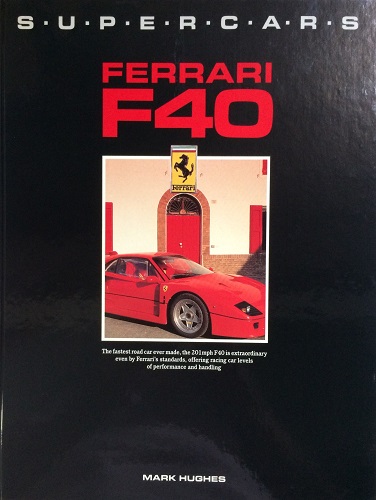
Mark Hughes
Softcover
64 pages
Out of Print.
New old stock.

Original price was: $55.95.$30.00Current price is: $30.00.
A generation ago the fastest road cars, many of them Ferraris, were spin-offs from the race circuits, but since then the technology gulf between road and track has grown steadily wider. Or at least that was the way the course of road car development looked until the arrival of the Ferrari F40 in 1987. With breath-taking bravado, Ferrari launched this street-legal racing machine as the fastest road car ever seen.
The F40 is the first car for public sale capable of exceeding 200mph. And it gets there faster than any rival: it can accelerate to 60mph in 4.5sec, to 120mph in 11.5sec. Naturally, it has handling to match its outrageous speed. Only the Porsche 959 comes close to the F40’s capabilities, yet around Ferrari’s tight test track at Fiorano a 959 is reckoned to be 10 seconds a lap slower.
Ferrari has accomplished this superiority over all-comers by using racing experience to pack a formidably powerful engine into a lightweight chassis carrying race-bred suspension. The F40 is truly a racing car for the road. Indeed, so much have racing requirements dictated the car’s rationale that a customer, in theory, need do little more than kit himself out in helmet and overalls to take his car to the grid.
At the heart of the F40 is the most powerful engine ever put in a road car, ignoring the activities of specialist tuners. A 2.9-litre V8 carrying twin turbochargers punches out 478bhp, 20 per cent more than the GTO from which the F40 is derived. Even the rather heavier 959, a 197mph car, has to settle for 450bhp. And, says Ferrari, another 200bhp is comfortably available for racing versions by making simple modifications.
Putting its power through a five-speed gearbox, this engine sits in an advanced chassis which uses composite materials — Kevlar, carbonfibre, glassfibre, Nomex — bonded to a steel frame to save weight and strength. The resulting rigidity, and the handling finesse this promotes, is one of the most impressive qualities you discover when driving an F40. The stunning bodywork, the work of Pininfarina, is also made of composites. The most powerful of all supercars is also the lightest.
The F40 has arrived at a time when the supercar market is more buoyant than ever before, earning itself instant investment status thanks to great demand from Ferrari customers. It really is a very special supercar.
In stock
Mark Hughes
Softcover
64 pages
Out of Print.
New old stock.
| Weight | 1.300 kg |
|---|---|
| Dimensions | 33.5 × 26.0 × 1.10 cm |

Reviews
There are no reviews yet.